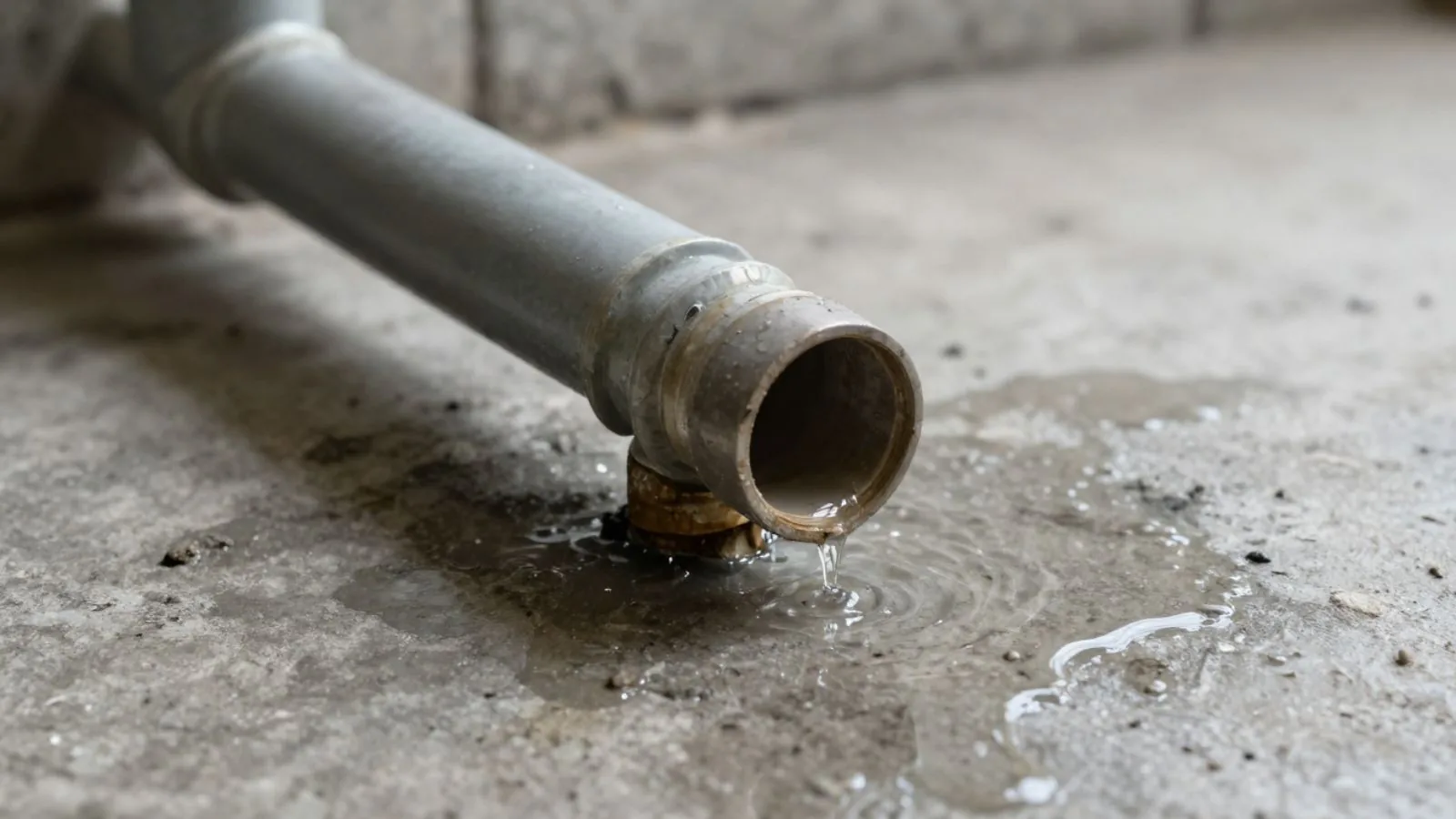
A frozen pipe that has split is an emergency the moment it thaws, and our 24/7 line is open for exactly that call. Turn off the main water valve, open the faucet nearest the frozen section, and keep people and pets out of rooms where water reaches outlets. Never use an open flame or a torch to thaw a pipe.
Ice does not usually break a pipe where it forms. Pressure builds between the ice blockage and a closed faucet, and the pipe splits at its weakest point. The leak often shows up only after the thaw, when water starts moving again.
When a frozen pipe becomes a flood
Water pours from a split pipe the moment ice melts, and that can happen while you are at work or asleep. A pipe on an exterior wall, in an unheated garage, or in a crawl space is the usual candidate. A slow trickle from a faucet that was dry the night before is the first sign that the blockage is still in place.
If you suspect ice, act before the thaw. Close the main valve, open the affected faucets and call a plumber. If water is already running, call us, because every minute of flow reaches more drywall and flooring.
Shut off
Close the main valve so thawing ice cannot become running water.
Thaw gently
Warm the pipe with a hair dryer or warm towels, working toward the faucet. No open flame.
Check for splits
Look for wet spots, bulges or frost on the pipe, then restore water slowly and watch.
Call for drying
Any water that escaped needs extraction and drying, even if it looks like a small stain.
What to expect from the cleanup
We start with moisture meters and a thermal camera to find water that traveled along framing or ran down inside a wall. Water from a split supply line is Category 1 at first. Extraction, removal of saturated insulation and drywall, and structural drying then follow.
Frozen-pipe losses are often hidden. A split behind a bathroom wall or above a ceiling can soak insulation for hours. A thermal camera lets us confirm the wet area before we cut, so openings stay as small as the damage allows.
Frost on a pipe
Visible frost or a bulge on an exposed pipe shows ice is present.
No water at a faucet
A tap that runs dry on a cold morning often has ice upstream.
Stain after a thaw
A new ceiling or wall stain on a warm day can mean a split pipe has started flowing.
Sound in the wall
A hiss or drip behind drywall after temperatures rise points to a split.
Water coming through a ceiling or wall?
Shut the main and call the line.
How common is this in O'Fallon?
We do not quote a local freeze count here, because we would rather send you to the source than guess. The National Weather Service St. Louis office publishes climate normals for the region, and any hard freeze can put a vulnerable pipe at risk. What matters for your house is where the pipes run.
Check lines in exterior walls, garage walls, attics, crawl spaces, and under kitchen and bath sinks on outside walls. Disconnect garden hoses before cold weather and know where your main shutoff is. The water utility serving your street, whether the City, Missouri American Water or Public Water Supply District No. 2, can confirm where the meter and valve sit.
Cost factors for frozen pipe damage
Time between thaw and shutoff
Hours of flow reach more rooms. A leak caught early may stay in one wall.
Where the pipe ran
A pipe in an attic wets ceilings below it. A pipe in a crawl space wets insulation and joists.
Materials
Insulation, drywall, flooring and cabinets are priced differently.
Drying time
Wall cavities and subfloors dry slowly, so equipment may run for several days.
A typical homeowners policy covers frozen-pipe repairs and the water damage that follows, according to the Missouri Department of Commerce and Insurance. Check your own policy for exclusions such as a vacant house or heat that was left off. Want your real number? Call (636) 747-8964.
Related cleanup pages
If the water ran through a ceiling, read about ceiling water damage repair. For standing water on the floor, see water extraction. If the pipe was in a crawl space, crawl space water damage explains insulation and joist drying.
Frozen pipes near Main Street
Older buildings with unheated porches and cellars are the most exposed. The Historic Downtown O'Fallon page explains why.
Frozen Pipe Water Damage questions
Do you handle frozen pipe water damage emergencies at night or on weekends in O'Fallon?
Yes. Dispatch runs 24/7, including nights, weekends and holidays, which is often when a thaw happens. Shut off the main valve, call, and a crew is sent when one is available. We do not promise an arrival window.
Is it safe to thaw a frozen pipe myself?
Yes, if you do it gently. Use warm air from a hair dryer or warm towels, and never use an open flame. Keep the faucet open and the main closed until you know the pipe is intact.
Does a frozen pipe always burst?
No. Many freeze and thaw without splitting. But a pipe that froze once may be weakened, so check for wet spots after restoring water.
How do I find a leak after a thaw?
Look for stains, damp insulation and a meter that moves with fixtures off. A moisture meter and thermal camera find hidden wet areas without opening walls.
Does insurance cover frozen pipes in Missouri?
A typical homeowners policy covers repairs to frozen pipes and the resulting damage, per the Missouri Department of Commerce and Insurance. Policies vary, so check yours or ask your insurer.